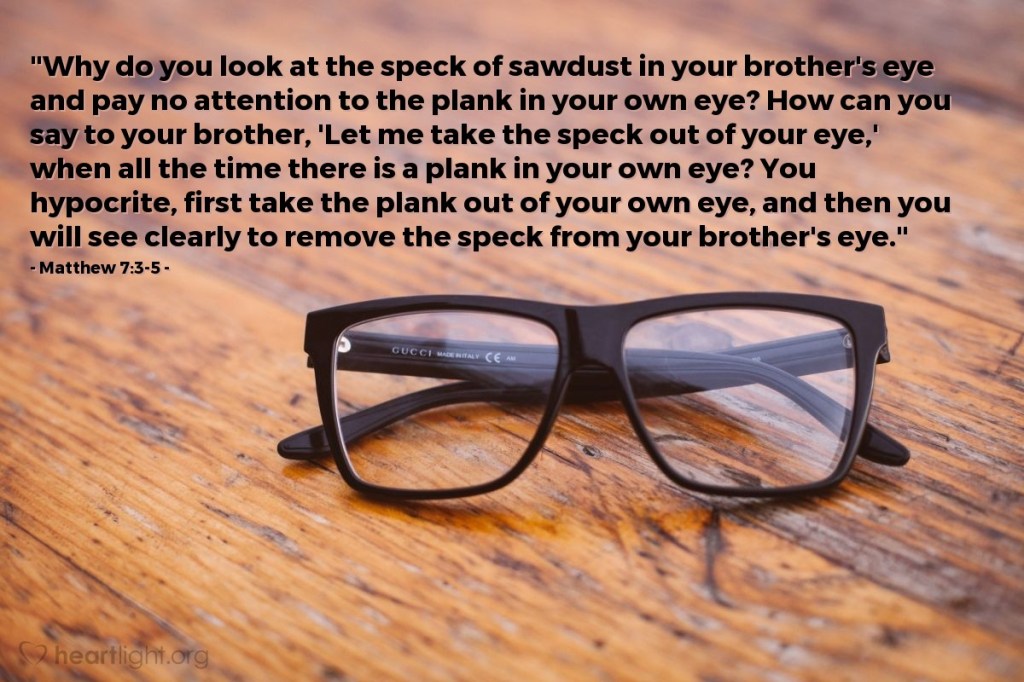
Matthew 7:3–5 is often misinterpreted as a blanket excuse to dodge accountability. You know the routine: “Only God can judge me,” “You sin too,” or the passive-aggressive meme someone once sent me: “Make sure you’re as disgusted by your own sins as you are by others’…”
That last one wasn’t just sent but rather delivered with the question, “Is this theologically correct?” And while I’m no expert, and I fully leave room for the possibility that I might be wrong, I don’t think that one, especially, is theologically sound. Actually, I find it a bit insidious.
Here’s why: I agree with the sentiments above in principle. Yes, only God can ultimately judge (James 4:12). Yes, Jesus is the propitiation for our sins (1 John 2:2). And yes, I sin every single day. The fact that I don’t steal or kill is immaterial; sin is sin.
I use more colorful words than I should when I’m frustrated. I have a hair-trigger temper and a tongue that gets ahead of my sanctification. I get overly indignant in situations where I should trust God’s justice. I can be forgetful or wildly inappropriate in serious moments. The list is long. And I am disgusted by my sins – not in a self-hating way, but in a sober, “this is not who Christ calls me to be” way. I repent. I ask Jesus for forgiveness. I am actively working on these things.
So if I agree with the memes in principle, why do they bother me? Because the way people use them is actually the very hypocrisy Matthew 7:3–5 warns against. It’s the moral equivalent of, “I’m rubber and you’re glue…” If you’re too young to remember that one, God bless you.
Matthew 7:3–5 doesn’t say, “Remove your plank and then mind your own business forever.” It says: remove your plank so that you can see clearly to remove your brother’s speck. The point is clarity, not silence. Sometimes both you and your neighbor have planks; sometimes both have specks but the size of the debris makes very little difference. Removing your own obstruction doesn’t make you spiritually perfect, either; it just means you can see well enough to help someone else with love and gentleness.
When people toss out lines like “only God can judge me,” what they’re really doing is refusing to acknowledge their own sin while shifting the blame onto the person hurt by their behavior. If someone steals my car, I’m going to feel some type of way about it. That feeling doesn’t mean I think I’m holier or more deserving of God’s love, but it does mean something wrong happened, and a normal human emotion followed. Scripture never tells the harmed party to pretend sin didn’t occur.
So no, I don’t buy the idea that “everyone sins; therefore, no one can hold anyone accountable.” Jesus didn’t operate that way. He called out sin directly, taught His disciples to correct one another gently, and instructed us to speak truth in love. Accountability is not un-Christlike; cruelty is. Silence in the face of harm is not holiness…it’s conflict avoidance.
Knowing my own shortcomings doesn’t mean I’m required to stay quiet when someone’s actions hurt me or others. Staying quiet is dysfunctional. And let’s be honest: memes aren’t arguments. They’re definitely not theology. They’re…memes. Fun, yes, but they often lack nuance.
When Jesus told us to address the specks in our own eyes, He wasn’t giving us ammunition to use Scripture as a means to dodge responsibility. He was speaking to all of us. So if you’re reaching for Matthew 7:3-5 to silence someone else, make sure your eyes are clear, too, because it looks like you might have gunk in your eyes that might need tending to.
 Kintsugi Faith
Leave a comment