Because I am in seminary, I rarely get the chance to read books purely for “fun” anymore. Not that I hate reading my textbooks, as my nerdy self quite enjoys them. I think that comes from enjoying the subject matter. Undergraduate work can be hit-or-miss in terms of interest. Reading my Biology textbook felt like a punishment, but reading assignments for my “Fairytales in the European Context” class were genuinely enjoyable. As a bonus, it counted as a German credit, which brings me nicely to my next point.
My family lineage is primarily German. I have a great deal of Irish and Scottish ancestry as well, but my maternal grandmother’s side is overwhelmingly Germanic. For a long time, that was something I carried with a certain amount of shame because of what happened during World War II (and WW I, for that matter).
In many ways, I found myself echoing J.R.R. Tolkien’s sentiment when he lamented that “the time is not far distant when a German name will no longer be a source of pride.” Tolkien, whose own family was of German descent, refused to let the Nazis define either his heritage or his identity, even while openly rejecting their racist ideology.
History and maturity have given me a much more nuanced perspective as well. Not every German citizen was a Nazi. Not every German supported what happened. Some people kept their heads down because survival is complicated. Many Germans alive today were children during that time—or were born long after it—and I am not in the business of blaming people for things far outside their control. Neither am I willing to let one of history’s darkest regimes permanently rob me of connection with generations of German ancestors.
So when Angel Studios introduced me to Dietrich Bonhoeffer, I was surprised that I had somehow never really encountered him.
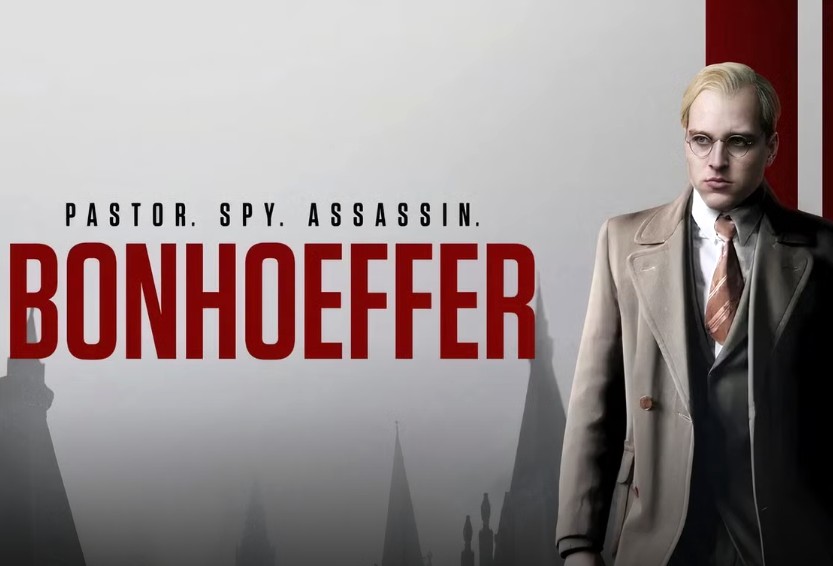
I knew Barth, Lewis, Luther, Augustine, Wesley, Irenaeus, Nouwen, and many other theologians. But Bonhoeffer? Somehow, I missed him. A German pastor who became involved in resistance efforts against Hitler? A theologian who challenged the church’s silence in the face of evil? A man who studied in America and was deeply impacted by the Black church and the fight for civil rights?
As a Christian? As a seminarian? As a part-German? I needed to know more.
The more I learned, the more fascinated I became. I bought Bonhoeffer’s Psalms at our local bookstore, Marigold’s, for three dollars (which is basically a theological treasure-hunt victory), and eventually purchased Eric Metaxas’ massive biography. Full disclosure: I am not finished with it yet. Seminary has a way of taking over every available moment. I am not presenting myself as a Bonhoeffer scholar. I am simply someone who encountered his story and wanted to understand him better.
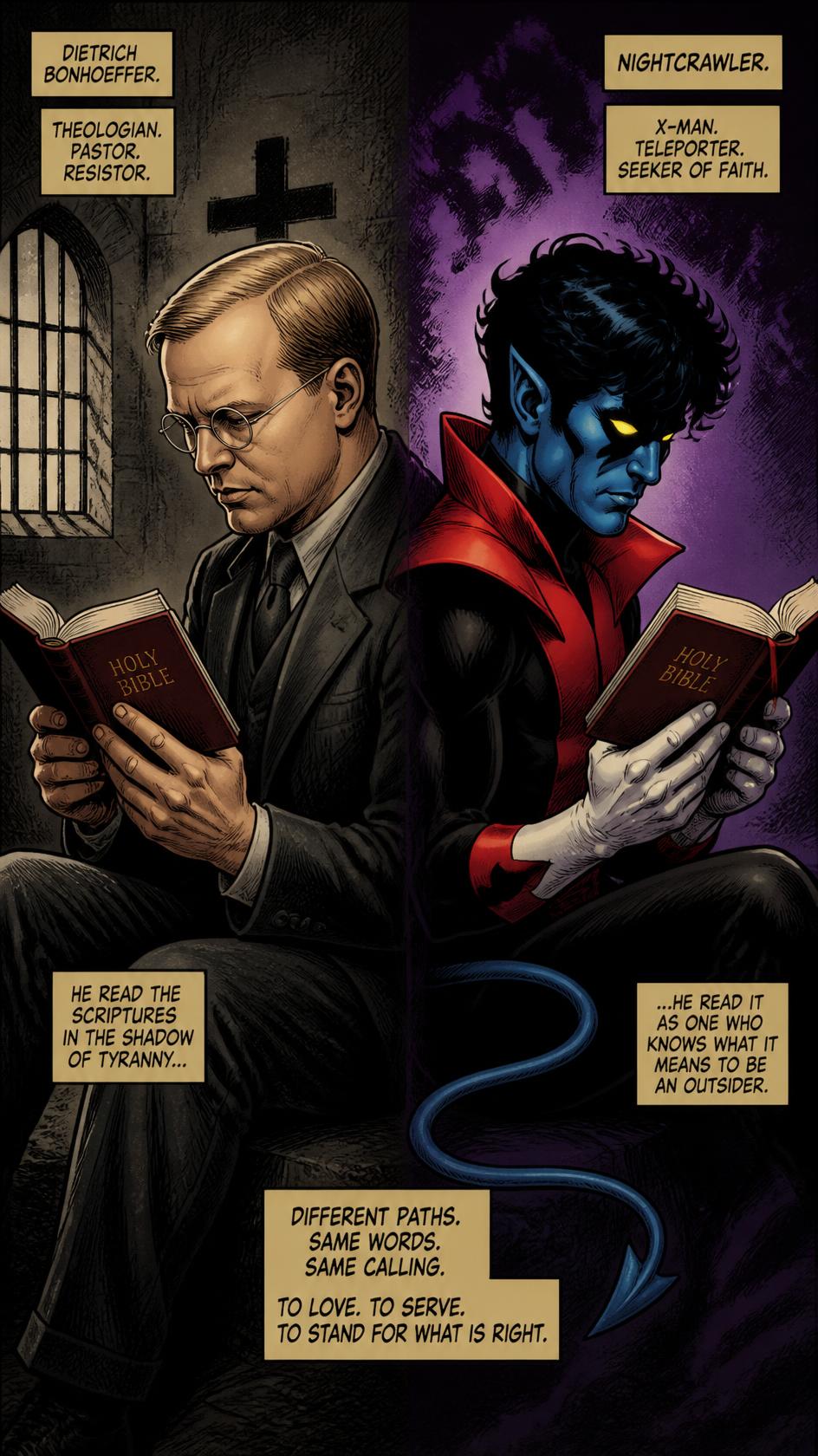
Which is probably why my brain immediately made an unexpected connection. The X-Men –
As a child, I adored that merry band of mutants because I struggled to find my own place in the world. Undiagnosed ADHD, and the anxiety and depression that grew out of childhood trauma, left me feeling like I was operating by a completely different set of rules. Everyone else seemed to know instinctively how to exist, while I was trying to decipher a handbook I’d never been given.
Then there were the X-Men. They were heroes, feared for being different. Judged before they were known. Outsiders who still chose to protect a world that often hated them.
I never felt like a superhero, but they made me wonder if there was something worthwhile about being different. (Spoiler alert: there was. My ADHD helps me recognize patterns, and Scripture is full of patterns…but that’s another essay.)
My favorite X-Man has always been Wolverine. Part of that was because when you’ve experienced trauma and always feel like the outsider, anger becomes an easy place to live. Feeling trapped in your own mind while everyone else seems happy, normal, and functional is exhausting. That’s why the friendship between Wolverine and Nightcrawler has always fascinated me. A more unlikely duo there never was.

Kurt Wagner, better known as Nightcrawler, is one of the most unusual members of the X-Men. Abandoned at birth, raised as an attraction in a circus, and treated as a monster because of his appearance, Kurt never had the ability to blend into society the way many other mutants did. Rogue could hide her differences behind gloves. Cyclops could hide behind sunglasses. Jean Grey could pass as human so easily. Even Wolverine, despite his claws and attitude, could maneuver through the world without immediately being identified as something else. Kurt never had that luxury.
Yet despite being rejected, feared, and treated as less than human, Nightcrawler maintained his faith. Depending on the writer, the details of his theology change, but the core remains: Kurt believes in God, grace, forgiveness, and the worth of every person. He refuses to let others’ hatred turn him into someone hateful himself.
The first time I ever heard Scripture quoted in popular culture was actually because of Nightcrawler. In the 1990s X-Men animated series episode “Nightcrawler,” Kurt talks with Wolverine about faith. Logan, naturally, is skeptical.
But by the end of the episode, we see Wolverine reading Scripture:
“Surely God is my salvation; I will trust and not be afraid. The LORD, the LORD himself, is my strength and my defense; he has become my salvation.”
Isaiah 12:1-2
That scene stayed with me in a very big way because seeing Wolverine, my hero, kneeling before God and reading from the Word, is already emotionally impactful on its face, but especially for me.
Years later, watching X-Men ’97, I saw another moment with Nightcrawler that reminded me why the character matters. Standing in the snow and confronting his brother, Graydon Creed, Kurt faces someone who represents everything that has hurt him: hatred, rejection, and fear, all while being blood-related, which is another layer of pain. Yet Kurt does not respond by becoming what hurt him as Graydon Creed did.
And that is where I see the connection to Bonhoeffer. Bonhoeffer also lived in a world where people were being labeled, dehumanized, and treated as disposable. While studying in the United States before World War II, he developed deep relationships with members of the Black community and was profoundly impacted by the fight for civil rights. He saw the injustice happening in America and recognized the same destructive ideology poisoning his own country. He had opportunities to remain safe elsewhere, but he chose to return to Germany…to stand with people who were suffering.
Both Bonhoeffer and Nightcrawler wrestle with the same question: What does faith require of us when the world is broken? How do we respond in the face of evil?
Neither man presents an easy answer. Neither one suggests that courage is simple. But both remind us that faith is not passive. It is not merely something we believe when life is comfortable. Faith calls us to action.
One wore a pastor’s collar. The other wears a superhero costume.
One fought the monsters of history. The other fights monsters of prejudice and fear.
But both remind us that even in a world full of darkness, we do not have to live afraid.
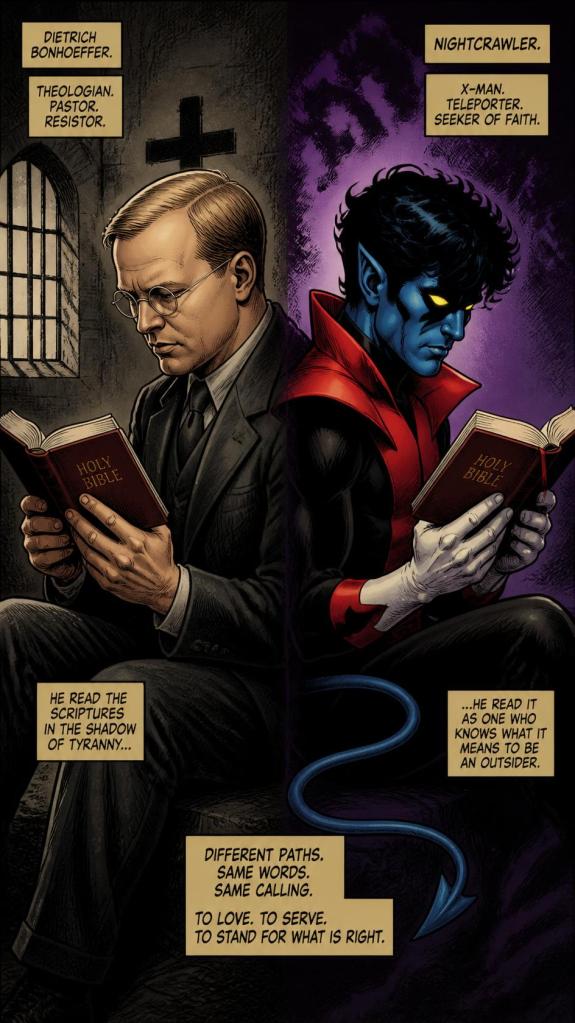
“Surely God is my salvation; I will trust and not be afraid.”
Isaiah 12:2


Leave a Reply